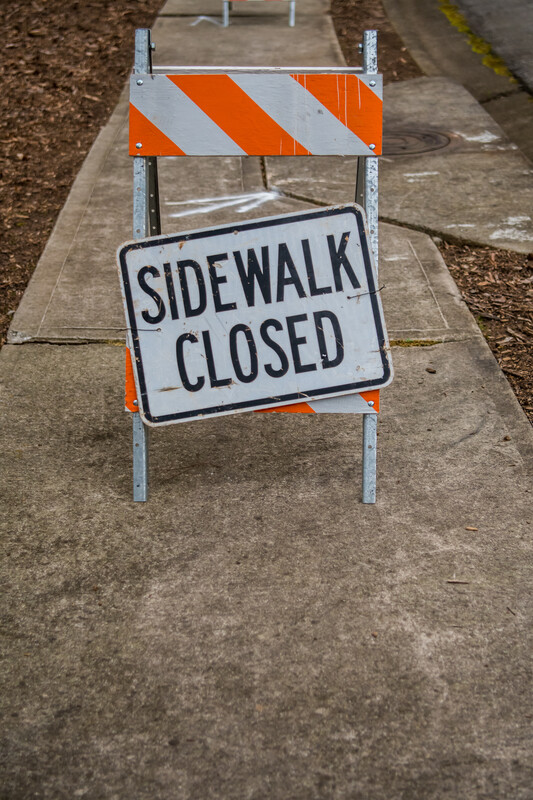
2025 Sidewalk Bay Replacement Results

Ward 9 Sidewalk Repair Program

Councillor Clark thanks all the residents that took the time to reach out to the Ward 9 office in 2025 to have sidewalk bays inspected, repaired and/or replaced. Each report is first inspected by our roads department. If there is a tripping hazard, staff will mark the sidewalk. Subsequently, it will be ground down level or have a temporary asphalt repair. Sidewalk bays that need replacing are included in a city-wide procurement process to find a contractor that can replace the bays. If you wish to report a damaged sidewalk or curbing that is a trip hazard, please email details to ward9@hamilton.ca

We are pleased to report that our Ward 9 program has successfully replaced a record 16 klms of sidewalk bays during this term, preventing trips and falls. Thank you ward 9 residents for your assistance.

2025 Replaced Sidewalk Bays 

16 Acacia Street , 30 Audubon Street North, 4 Crocus Court, 183 First Road West. 31 Foxmeadow Drive, 105 Gatestone Drive, 177 Gatestone Drive, 179 Gatestone Drive, 109 Gordon Drummond Avenue, 166 Gordon Drummond Avenue, 48 Highbury Drive 9 123 Highbury Drive, 125 Highbury Drive, 5 Joncaire Place, 20 Kingsview Drive, 22 Kingsview Drive, 24 Kingsview Drive, 26 Kingsview Drive, 49 Mistywood Drive, 57 Mistywood Drive, 20 Odessa Street, 27 Odessa Street, 123 Odessa Street, 1809 Rymal Road East, 1824 Rymal Road East, 1825 Rymal Road East, 1835 Rymal Road East, 1837 Rymal Road East ,1841 Rymal Road East, 1843 Rymal Road East, 1847 Rymal Road East, 1865 Rymal Road East, 1869 Rymal Road East, 1877 Rymal Road East, 1883 Rymal Road East, 1885 Rymal Road East, 1889 Rymal Road East, 1893 Rymal Road East, 1893 Rymal Road East, 1899 Rymal Road East, 1901 Rymal Road East, 1907 Rymal Road East, 1907 Rymal Road East, 1910 Rymal Road East, 1911 Rymal Road East, 1933 Rymal Road East, 1933 Rymal Road East, 1941 Rymal Road East, 1947 Rymal Road East, 1951 Rymal Road East, 1953 Rymal Road East, 1957 Rymal Road East, 1967 Rymal Road East, 34 Spring Garden Crescent, and 11 Tossell Avenue.

Council supports Clark’s motion which eyes rare court action to close odour-plagued Stoney Creek landfill

Courtesy of The Spec

By Kate McCulloughReporter

City councillors have voted to seek a judicial order to try to close the odour-plagued Stoney Creek dump — a legal first in Hamilton.

That rare legal pitch won’t happen fast, so councillors also voted Wednesday to ask the province to step in and “expedite” the closure of the GFL-run landfill.

Both motions from Upper Stoney Creek councillor Brad Clark were unanimously supported in a general issues committee meeting Wednesday that attracted more than a dozen landfill neighbours. Those votes are expected to be ratified at a council meeting next week.

The first motion would direct the city solicitor to bring an application to Superior Court to close the landfill for up to two years or “until the court is satisfied the ongoing public nuisance has been fully abated.”

“These odours are pervasive,” said Clark, who represents the Stoney Creek Mountain community. “These odours seep into their homes. Residents are buying air purifiers and putting them in every room to try to keep their house from smelling like a landfill.”

GFL did not immediately respond to Spectator requests for comment on the council vote Wednesday. But the company submitted a letter for the meeting emphasizing it expects major sources of odour to be fixed by the end of this year.

Asking the courts through the Municipal Act to close an operation if it is a public nuisance is “very rare,” Clark told The Spectator. One of the only instances in recent memory, he said, was a City of Newmarket legal application that resulted in a nine-month closure order issued to an organic recycling facility in 2006.

“It’s an unprecedented case in Hamilton,” Clark said.

The two motions account for the different timelines for each process, he said.

Pursuing court action involves gathering evidence and building a case, Clark said. City solicitor Lisa Shields said staff would bring a report to councillors outlining legal tactics and timelines in the first quarter of 2026.

“The other one is really advocating to the province saying, ‘We’ve had enough,’” Clark said. “‘It’s not going away. It’s time you expedite the closure process for the landfill.’”

Odours from the GFL-operated landfill — which have been compared to wet garbage, dead fish, cat pee and a “rotten egg smell” — have plagued neighbouring residents for several years.

There have been more than 3,600 complaints since 2023, about two years after GFL took over, Clark said.

The dump’s operator was charged in May with 10 provincial offences related to an infamous “summer of stink” in 2023.

In a letter to the committee, GFL vice-president David Richmond promised odour-mitigating steps should be largely finished by the end of 2025. That includes finishing the relocation of old waste — work ordered by the province — and the construction of a new, enclosed leachate treatment facility.

A pond for leachate — or garbage juice — was a major source of recent odour woes, he previously told residents in a community meeting.

Richmond said in his letter the company collaborated with the province and city to address infamous past odour woes in 2023. In a community survey that winter, more than 90 per cent of residents “noted significant improvement,” he wrote.

He also noted the landfill also contributes to the community via royalties, taxes and other agreements. The financial benefit in 2025 is expected to be about $4 million.

If the Stoney Creek facility is closed, waste-makers would be responsible for finding a new commercial landfill, said public works manager Jackie Kennedy.

“The waste from this landfill would not go to our municipal landfill,” she said.

Residents say years of odours have affected their physical and mental health.

“We are physically trapped in our home,” said delegate Tatyana Graham, who lives about 300 metres away from the dump. “It’s like a COVID lockdown all over again, except this time it’s the air outside that’s the threat.”

Burning eyes and throats, headaches, nausea, dizziness and difficulty sleeping are among the reported symptoms, she said.

“No amount of revenue is worth children gagging and coughing as they wait for their school bus,” she said.

The Hamilton-Wentworth District School Board has also scrapped long-standing plans to build a new 650-student school on a board-owned lot at 399 First Rd. W. near the dump after the Ministry of Education directed them to do so, area residents learned in late September.

Kathleen Taylor, who lives less than a kilometre away, remembers waking up on an August 2023 night to a strong cat-pee stench.

“I woke up from a dead sleep gagging,” she said.

Taylor and Graham were among more than a dozen people in the gallery on Wednesday, many holding signs calling on officials to “close the dump.”

“I bought a townhouse but got an outhouse,” one sign read.

A small crowd cheered after the committee approved each motion.

Taylor she she’s “cautiously optimistic” about the future of the dump.

“It’s definitely a win,” she said.

Request Province to Expedite Closure of SCRF

CITY OF HAMILTON
NOTICE OF MOTION
to be debated on November 12, 2025. Residents are encouraged to submit their comments, and or experiences to clerk@hamilton.ca and please include your home’s proximity to the landfill i.e. 1k, 2k, 3k etc.


General Issues Committee Date: October 22, 2025
MOVED BY COUNCILLOR B. CLARK……………………………..………………………….
Request for the Closure of the GFL Stoney Creek Regional Facility, 65 Green
Mountain Rd. W., Stoney Creek


WHEREAS, the Minister of Education has recently notified the Hamilton Wentworth
District School Board that the previously approved site for the Nash Neighbourhood
School is “unsuitable” for school children;

WHEREAS, several hundred children live with their families within 3 km of the GFL
landfill are experiencing these offensive odours daily;

WHEREAS, given that the Provincial Government has deemed the Nash
Neighbourhood future school site to be “unsuitable” for students due to the persistent
odour nuisance of almost three years;

WHEREAS, residents are now questioning the suitability of living in their homes, several
hundreds of which are older than the landfill;

WHEREAS, the Ministry of Environment Conservation and Parks charged GFL for only
three odour complaints from 2023 out of several thousand over three years; and

WHEREAS, the Ward 9, 5 and 10 Councillors can attest that these Hydrogen Sulfide
odours have continued and were excessively strong this past week.

THEREFORE, BE IT RESOLVED:
That the Mayor and City Council respectfully request that the Premier and his Cabinet
direct the Ministry of Environment, Conservation and Parks, to begin the process to
expedite the closure of the GFL Stoney Creek Regional Facility, 65 Green Mountain Rd.
W., Stoney Creek

Photo-radar ban threatens speeding crackdown on collision-prone Upper Centennial Parkway

The city plans to add a speed camera on a stretch of Upper Stoney Creek parkway, where four people died this year — unless Ontario bans the technology this month.

Courtesy of The Hamilton Spectator

By Matthew Van Dongen

A looming photo-radar ban will prevent Hamilton from adding speed cameras on collision-prone Upper Centennial Parkway, where four people have died in crashes this year.

City council approved plans in September to double its four-camera arsenal and add one of the automated speed enforcement (ASE) boxes along the parkway atop the Stoney Creek Mountain.

A new parkway safety study — requested after a double-fatal collision near the intersection of Highgate Drive — showed average driving speed above the limit and concerning clusters of collisions at intersections along the route.

But late last month, Premier Doug Ford announced he would ban the “cash grab” speed cameras after the provincial legislature reconvenes Oct. 20 — despite growing protests by dozens of cities supportive of photo-radar, including Hamilton.

Ward councillor Brad Clark said he will be “heartbroken” if the threatened ban axes a safety measure at least some residents are clamouring for on the increasingly busy parkway.

“We have experienced fatalities on that road; families have lost loved ones because of speeding on that road,” he said in an interview. “We have a tool to slow people down — one that has proven to be effective — and you’re going to prevent us from using it?”

Speed cameras by the numbers in 2025

3,516 Tickets handed out by Hamilton cameras this year (through end of August)

1,114 Location with most tickets (Highland Road, west of Upper Centennial)

$559,000 Ticket revenue from four rotating cameras (end of August)

27 per cent Percentage of additional drivers obeying speed limit after camera installation

More than 20 mayors, including Hamilton Mayor Andrea Horwath, submitted a written appeal to Ford last week to rethink the threatened ban. Ontario’s police chiefs, a study from Toronto’s Hospital for Sick Children (SickKids) and Hamilton’s own camera data all point to the technology being effective in slowing speeders.

The premier responded swiftly in his own letter, scolding “greedy” municipalities for wanting to keep ticket revenues and vowing instead to fund traffic-calming infrastructure like speed bumps to bring speeding “down to zero.”

Hamilton already uses its revenues from speed tickets exclusively to pay for traffic safety improvements, noted Clark.

But the larger challenge on Upper Centennial, he added, is that the former provincial highway above the escarpment has speed limits between 60 and 70 km/h.

City traffic staff have said they cannot recommend speed bumps on arterial roads that are designed to move traffic more quickly and efficiently.

The planned new speed camera is supposed to be located on the parkway between Rymal and Highland roads.

The recent safety study showed 15 out of every 100 drivers were travelling faster than 92 km/h — or more than 22 kilometres over the posted limit — in a stretch of the parkway bookended by the two latest fatal crashes on Upper Centennial.

In August, two people died in a fiery two-car crash near Highgate Drive, the entrance to a small suburban enclave. Nearby, family members set up a roadside memorial for one of the victims, Joey Majerovich.

The status of that police investigation was unclear Friday. But a ward office update to residents said in that crash, it appeared a driver lost control while turning onto the parkway.

Just less three months earlier, a multi-vehicle collision killed a driver and passenger in a car on the parkway between Green Mountain Road and Mud Street.

Police later charged a 32-year-old Hamilton man with impaired and dangerous driving, as well as Highway Traffic Act charges alleging stunt driving and speeding over 140 km/h in a 70 km/h zone.

People are fed up with the “terrifying” speeding and road-racing that happens along the corridor, said near-parkway resident Alisa Bennett-Infanti.

“The drag racers keep me awake at night,” she said in an interview.

Bennett-Infanti called it a “mistake” for the province to axe speed cameras, “especially in school zones,” expressing hope the premier will reconsider and allow installation along Upper Centennial.

But she added automated enforcement can only do so much — so she is hoping the province comes through regardless on funding pricier road-design changes like traffic circles that force “straight line road racers” to slow down.

“We also need more police enforcement to catch these people who do not care — about cameras, the law, other people on the road,” she said.

“Speed cameras work great for people like me — but those (people) driving drunk at twice the limit at midnight, they don’t care about cameras.”

In the aftermath of the latest double-fatal on Centennial, Hamilton police ramped up in-person enforcement, issuing 57 traffic charges related to speeding, stunt driving and other unsafe behaviour in a crackdown in mid-September.

The city is also planning other road and traffic safety improvements, said Clark, including redesigned intersections and lowering the parkway speed limit to 60 km/h from the edge of the escarpment to Rymal Road.

But physical infrastructure changes take time, he said, and a speed camera could go into action within weeks — if the province lets it happen.

“I am appealing to the premier to be flexible,” Clark said, noting more and more municipal leaders are pressuring the government to reach a compromise. “We only have so many tools to slow people down on this roadway and we’re about to lose one of them.”